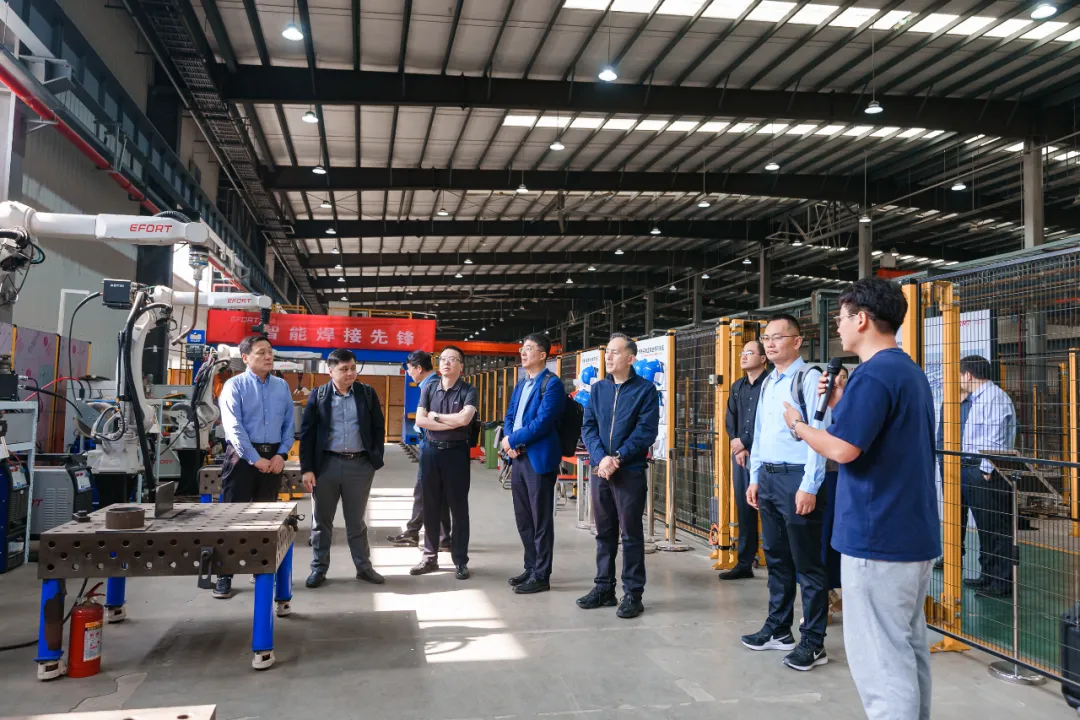
On 20 April 2025, the kick-off meeting for the ‘Autonomous Intelligent Arc Welding Robot Technology and Systems’, a key project under the ‘Intelligent Robots’ Key Programme of the National Key Research and Development Programme, was held at the Wuhu headquarters of Efort Intelligent Robot Co., Ltd. (hereinafter referred to as ‘Efort’).
Led by Efort, the project involves a consortium of eight organizations, including Harbin Institute of Technology, Xi’an University of Electronic Science and Technology, Shanghai University of Engineering Science, iFlytek Co., Ltd., Wuhu Xingjian Intelligent Robot Co., Ltd., Chengdu Canopus Robot Technology Co., Ltd. and China Shipbuilding Industry Corporation Huangpu Wenchong Shipbuilding Co., Ltd., among eight organizations.
The project aims to address bottlenecks in the intelligent development of welding robots for heavy industry sectors such as shipbuilding and steel structures, thereby promoting the flexible upgrading of the discrete manufacturing sector. The expert panel comprised Research Fellow Du Zhenjun, Executive Director of Shenyang Siasun Robot Technology; Professor Liu Hongzhong, Deputy Director of the National Key Laboratory of Precision Micro- and Nano-Manufacturing Technology at Xi’an Jiaotong University; Professor Zhang Jianhua, Head of the Department of Mechatronics Engineering at the School of Mechanical Engineering, University of Science and Technology Beijing; Research Fellow Yang Guilin, Director of the Innovation Institute of Robotics and Intelligent Manufacturing at the Ningbo Institute of Materials Technology and Engineering, Chinese Academy of Sciences; Zheng Junqi, Vice President of the Shanghai Electrical Science Research Institute; Professor Huang Panfeng, Dean of the School of Aerospace Engineering at Northwestern Polytechnical University; Researcher Ren Fei, Deputy Chief Process Engineer and Director of the Science and Technology Development Department at Shanghai Aerospace Equipment Manufacturing General Plant Co., Ltd., and Professor Liu Haitao from the School of Mechanical Engineering at Tianjin University, among other leading scholars in the field of intelligent robotics, who will provide technical oversight for the project.
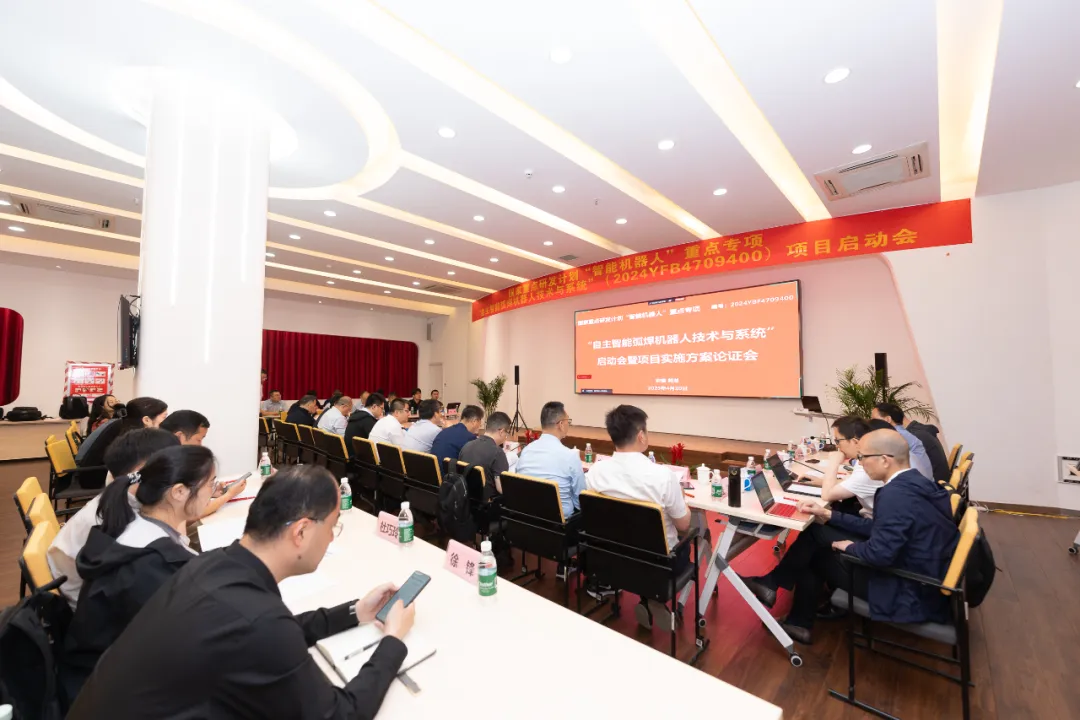
Xu Guanyu, Director of the Centre for Industrial Development Promotion under the Ministry of Industry and Information Technology, and Shi Hongqiang, Deputy Director of the High-Tech Division at the Anhui Provincial Department of Industry and Information Technology, attended the launch meeting and delivered speeches, whilst You Wei, Chairman of Efort, delivered a speech on behalf of the company. The meeting was chaired by Research Fellow Du Zhenjun, Executive Director of Shenyang Sinsong Robot Technology and the project’s lead expert.
Professor Zi Bin, Dean of the School of Mechanical and Electrical Engineering at Xi’an University of Electronic Science and Technology and the project leader, presented the project objectives and overall plan to the attending experts, whilst the principal investigators of each sub-project respectively reported on their practical implementation plans. Following several rounds of questioning and discussion, the panel of experts reached a consensus and unanimously approved the implementation plan.
The National Key Research and Development Programme represents the nation’s highest-level scientific and technological research initiative. Efort has emerged victorious from a field of numerous competing organizations to serve as the lead for the project, undertaking cutting-edge exploration and demonstration applications in the field of intelligent robotic welding. The concept behind the National Key Research and Development Programme project—which aims to establish a technical roadmap for Efort Intelligent Robot and a universal technology platform for intelligent robots—has once again received support and recognition at national level!
This project will complete the research, development and validation of the ‘intelligent welding’ module, a key process within the General Technology Platform for Intelligent Robots project. Addressing the characteristics of the heavy industry sector such as shipbuilding and steel structures, where welded components are characterized by a wide variety of types, small batch sizes and a high degree of differentiation, the project will establish an integrated, cloud-edge-end collaborative intelligent arc welding robot flexible manufacturing platform. It aims to achieve breakthroughs in the autonomous identification and extraction of workpiece and weld features under strong interference in unstructured environments, online welding quality inspection based on multimodal perception data fusion; complex task allocation and real-time multi-robot collaborative path planning for welding operations in confined spaces; the training and deployment of large-scale arc welding vertical models driven by both knowledge and data; and the system integration of multi-layer, multi-pass full-penetration welding based on cloud-edge-end collaboration. It will thereby demonstrate the batch application of autonomous arc welding robots on two types of flexible intelligent production lines: ship assembly and steel structure manufacturing.