Making spraying so easy!
Efort releases a new generation of platform-based painting robots
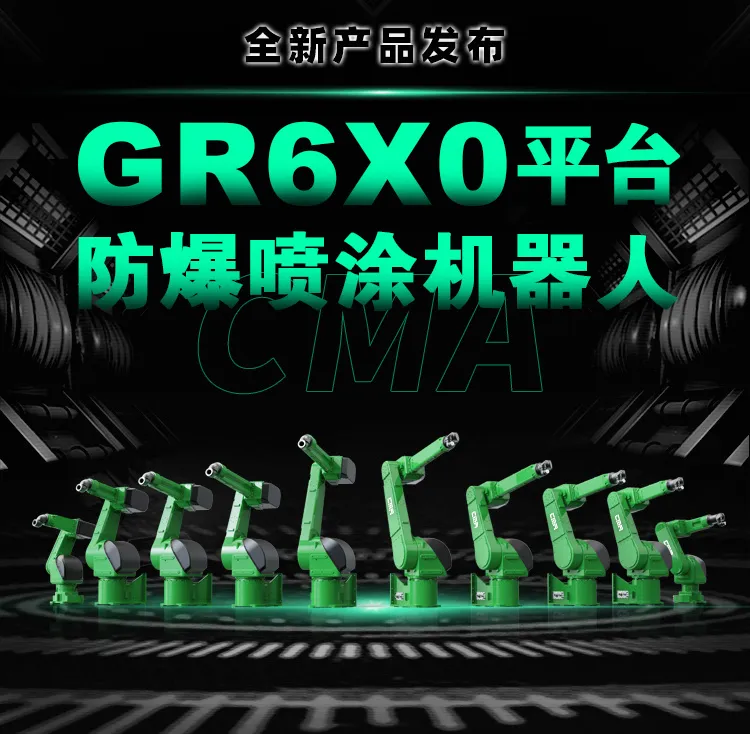
On 28 February 2025, Efort officially launched a new-generation spray painting robot platform based on a universal intelligent robotics technology foundation, whilst simultaneously unveiling the GR6150 series hollow-wrist spray painting robots and the GR6100 series offset-wrist spray painting robots.
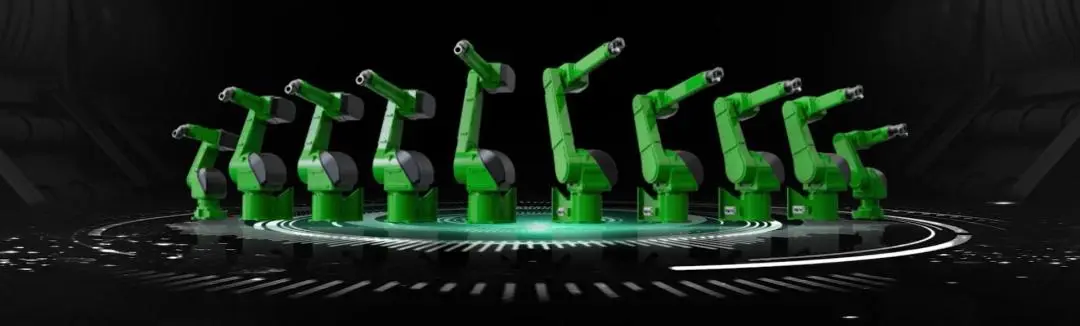
The GR6150 series of robots, featuring a hollow wrist design, have a payload capacity of 15 kg and reach lengths of 1500 mm, 2000 mm, 2200 mm, 2500 mm and 2900 mm. Five models, the GR6150-1500, GR6150-2000, GR6150-2200, GR6150-2500 and GR6150-2900, all designed for the automotive sector.
The GR6100 series of robots, featuring an offset wrist and a payload capacity of 10 kg, are available with reach lengths of 1700 mm, 2200 mm, 2400 mm, 2700 mm and 3100 mm. Designed for general industrial applications, the following five models have been launched simultaneously: the GR6100-1700, GR6100-2200, GR6100-2400, GR6100-2700 and GR6100-3100, all designed for general industrial applications.
The platform’s founding principle
We produce what the market demands
In 2024, automobile production and sales in the Chinese market reached new record highs, with both annual production and sales exceeding 30 million units, making it the world’s largest automotive market and securing its position as the global leader in production and sales for the 16th consecutive year. Sales of new energy vehicles in the Chinese market exceeded 9 million units, making it the world’s largest market for new energy vehicles and securing its position as the global leader for the 10th consecutive year. China’s automobile exports exceeded 5 million units, making it the world’s largest exporter of cars.
In the automotive industry, both the construction of new production lines for complete vehicles and the refurbishment of existing ones require the installation of a large number of painting robots; this, in turn, drives the widespread installation of painting robots on automotive components production lines. In the Chinese market, over 70% of painting robot sales are in the automotive sector; the automotive industry is the largest market for painting robots and represents a strategic battleground for manufacturers.
In the automotive industry, complete vehicles and automotive components vary greatly in shape and size, whilst the dimensions of spray booths are strictly limited; this places high demands on the reach configuration of painting robots. At the same time, in order to achieve flexible integration of peripheral painting process equipment and ensure painting quality, higher demands are placed on the integrated painting process equipment; including the robot’s main arm, process arm and wrist. As complete vehicles and components have relatively complex geometries, this places higher demands on intelligent and user-friendly programming.
The GR6150 series of spray painting robots, featuring a hollow wrist, have been specifically designed to meet the demand for flexible, high-quality spray painting in the automotive and automotive components sectors, as well as in specialist industries such as rail transport, aerospace, shipbuilding and construction machinery.
The GR6150 series of spray painting robots offers five reach configurations, catering to the spray painting requirements of workpieces of varying dimensions and spray booths of different sizes. The combination of process arms, hollow wrists that flexibly accommodate atomizers, rotary cups, spray guns, colour-change valves, gear pumps and proportional valves. The EPA spraying process package better meets the automotive industry’s stringent requirements for spraying process quality, whilst the EPS offline programming software better meets the industry’s demands for intelligent and straightforward programming.
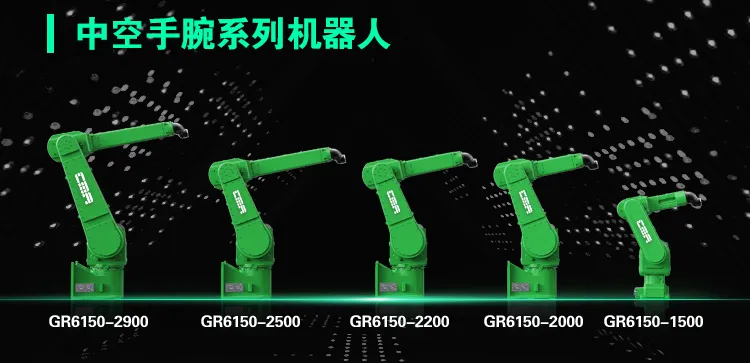
The GR6150-2900 can be used for spraying complete motor vehicles as well as large workpieces such as high-speed rail/train components, aircraft parts, ship components and construction machinery; the GR6150-2000, GR6150-2200, GR6150-2500 can be used for spraying automotive interior and exterior trim components, as well as medium-sized workpieces such as high-speed rail/train components, aircraft components and ship components; GR6150-1500 can be used for spraying small workpieces such as automotive headlamps and wing mirrors.
In the general industrial sector, faced with numerous sub-sectors, workpieces of varying shapes and sizes, and spray booths, as well as a wide range of materials such as metal, wood, ceramics and plastics, and various coating processes including liquid painting, powder coating, glazing and adhesive application, it is necessary to configure combinations of spray robots with different reach capabilities to address challenges such as the flexible integration of high-variety, low-volume workpieces, intelligent programming and the avoidance of singularities.
The GR6100 series of offset-wrist spray robots is specifically designed to meet the flexible spraying requirements of general industrial applications, including woodwork, furniture, ceramics, plastic components, metals, hardware, containers and energy storage units.
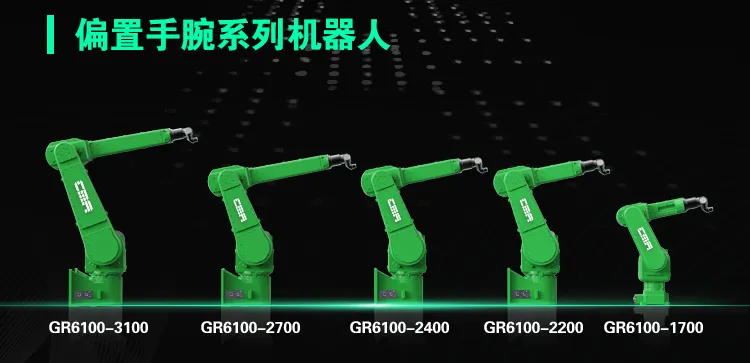
The GR6100 series of spray painting robots offers five different reach configurations, addressing the challenges posed by workpieces of varying sizes and shapes, as well as spray booths of different dimensions. The offset wrist effectively resolves singularity issues, whilst vision-based teaching and VR technology simplify programming for high-variety, low-volume workpieces. The EPS offline programming software facilitates intelligent programming for complex workpieces, the hollow process arm accommodates the installation of process equipment such as guns, pumps and valves, and the EPA spraying process package, combining software and hardware, addresses quality issues in the spraying process.
Platform benefits
Making spray painting robots so simple
The benefits of platform-based products are clear to see.
Compared with single-point spray robot models, the GR6150 series comprises five hollow-wrist spray robots, whilst the GR6100 series comprises five offset-wrist spray robots; together, these ten explosion-proof spray robots meet the requirements for different payloads, reach lengths and wrist configurations across various industry sectors, spray applications, materials, and workpiece shapes and sizes.
01. Making R&D more efficient
Based on market insights and customer requirements, Efort is able to rapidly iterate on its GR6150 series of hollow-wrist and GR6100 series of offset-wrist spray painting robots; its modular R&D approach enables rapid iteration of the GR6150-1500, GR6150-2000, GR6150-2200, GR6150-2500 and GR6150-2900 spray painting robots, as well as the GR6100-1700, GR6100-2200, GR6100-2400, GR6100-2700 and GR6100-3100 spray painting robots, resulting in shorter development cycles and a faster response to market demands.
02. Making manufacturing more reliable
The GR6150 and GR6100 series platform products are developed on the basis of Efort general-purpose industrial robot platform. These have been thoroughly validated by the market; as the GR6150 and GR6100 series platforms utilize these general-purpose robot platform products and technologies, they offer even greater product and technical reliability.
03. Making it easier to use
The ‘nesting’ structural design of the GR6150 and GR6100 series platforms enables partners and end customers to familiarize themselves more quickly with the integration, repair and maintenance of the painting robots. This makes integration easier for partners, whilst reducing integration costs and increasing integration efficiency. At the same time, end customers find the robots easier to use and maintain, resulting in lower operating and maintenance costs.
Platform Advantages
Making system integration so simple
It is plain to see that platform-based products facilitate system integration.
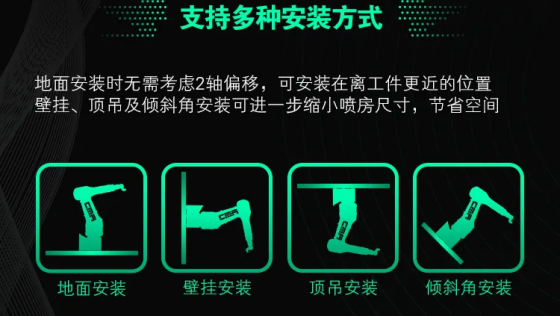
01. Supports multiple installation methods
The GR6150 and GR6100 series spray robots offer a variety of mounting options, including floor-mounted, side-mounted, overhead and angled configurations, to meet the flexible installation requirements of different spray booths and workpieces.
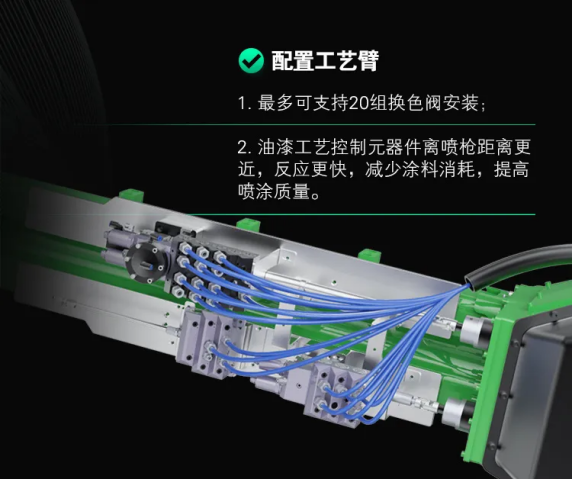
02. The robotic arm supports the integration of additional spray application actuators
The GR6150 and GR6100 series spray painting robot arms support up to two sets of gear pumps and 20 sets of colour-change valves. As the paint application components are positioned closer to the spray gun, they respond more quickly, reducing paint consumption and improving spray quality.
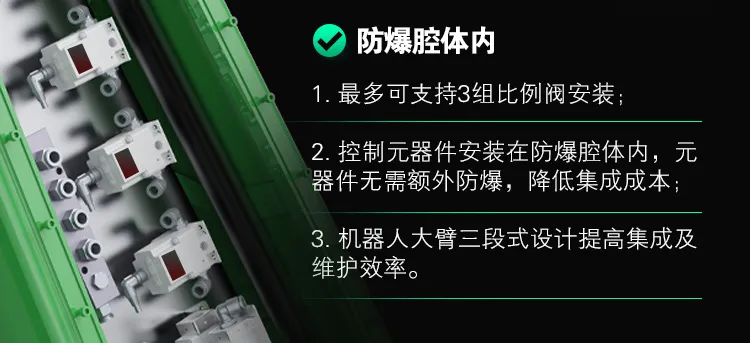
03. The explosion-proof enclosure supports the integration of additional spray coating process control devices
The GR6150 and GR6100 series spray painting robots can accommodate up to three sets of proportional valves and 20 sets of solenoid valves on their main arms. As the control components are housed within an explosion-proof enclosure, no additional explosion-proof measures are required, thereby reducing integration costs.
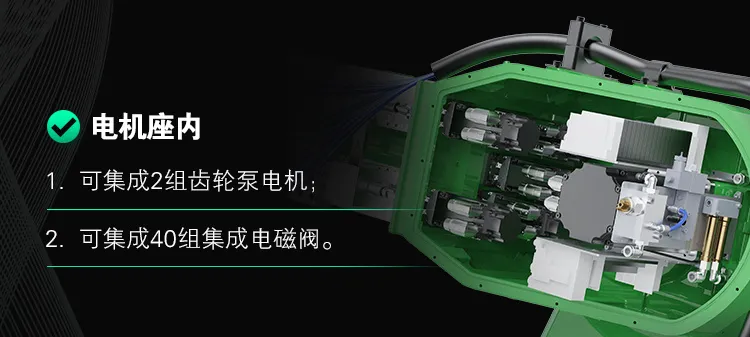
The motor mounts for the GR6150 and GR6100 series spray painting robots can accommodate up to two sets of gear pump motors and 40 sets of solenoid valves. With the paint process control components located closer to the spray gun, response times are faster and integration is more convenient.
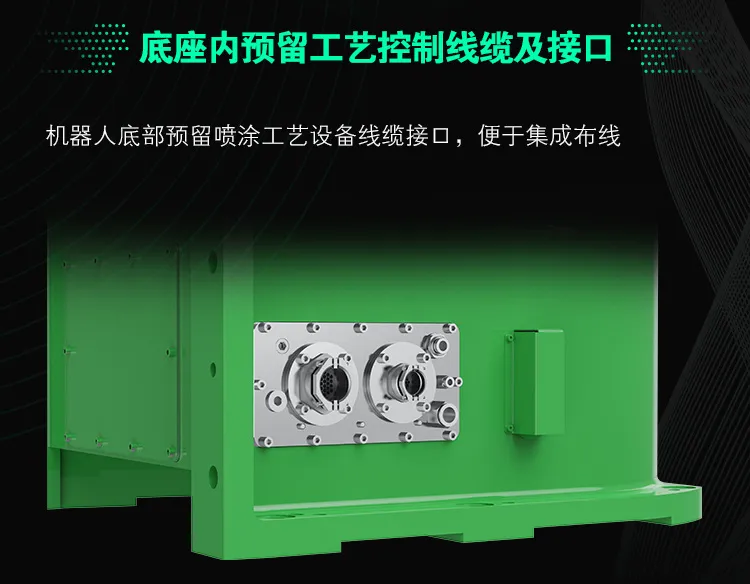
The GR6150 and GR6100 series spray robots feature preinstalled cable routes and connectors at the base for gear pump motors, proportional valves and other components, facilitating integrated cabling. The three-section design of the main arm allows for segmented disassembly and assembly, thereby improving both integration and maintenance efficiency.
04. Supports both hollow wrist and offset wrist configurations
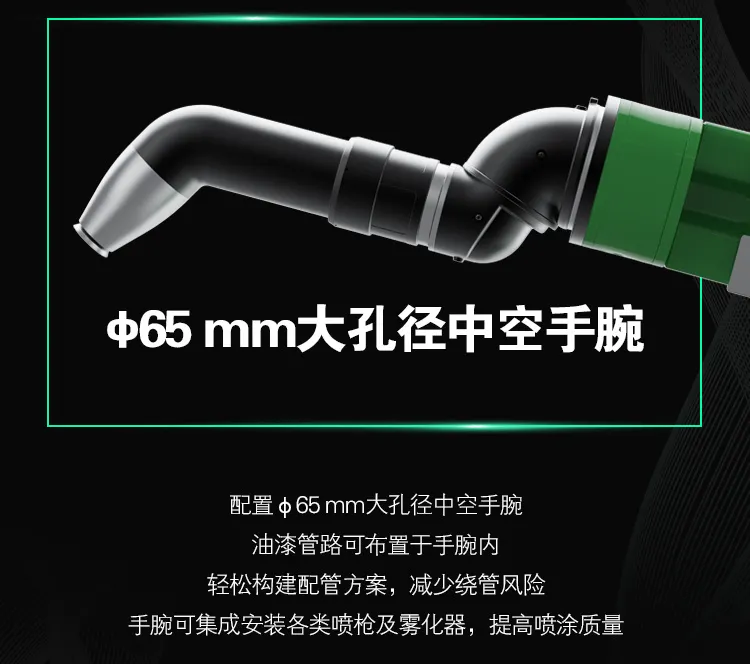
The GR6150 and GR6100 series spray painting robots are available with a hollow wrist option, featuring a large-bore hollow wrist with a diameter of 65 mm. The wrist’s cable entry point is protected, allowing the paint lines to be routed inside the wrist, thereby simplifying the pipework layout and reducing the risk of cable entanglement.
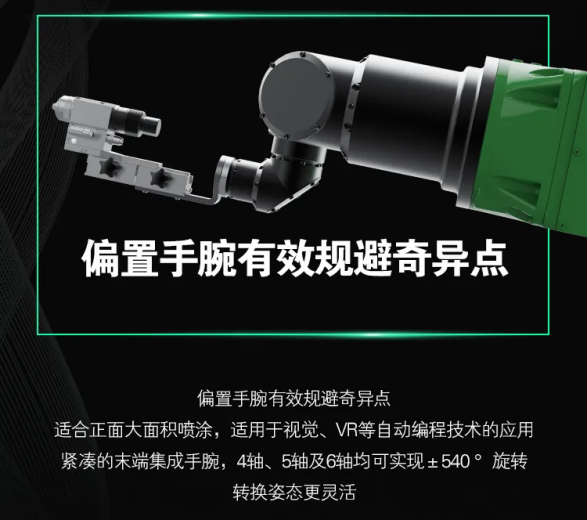
The GR6150 and GR6100 series spray painting robots are available with an offset wrist, have no singularities on the front face, are suitable for large-area front-facing spray painting, and are ideal for applications utilising automated programming technologies such as vision systems and VR.
Platform app
Making the spraying process so simple
Alongside the launch of the GR6150 and GR6100 series of painting robot platforms, EFORT has also released the EPA (EFORT Paint APP) painting process package.

The EPA spray coating process package incorporates four key systems: a process parameter system, a spray formulation system, a spray brush system and an integrated gear pump system. It meets the high standards for process quality in high-end applications, as well as the stringent requirements for flexible and customized production.
The process parameter system comprises five distinct process parameters. Working in conjunction with peripheral sensors, it enables real-time online control of the robot’s process parameters, allowing these parameters to be displayed and modified in real time. It flexibly calibrates various actuator sensors and optimizes them in real time, ultimately achieving closed-loop feedback and closed-loop control, thereby reducing downtime during product and colour changes.
The spray coating formulation system balances the functionality and practicality of the robots, enabling autonomous control of interfaces and hook-up formulations. As communication protocols have been established, engineers can monitor the spray coating status in real time, ensuring timely cleaning and supporting autonomous control of colour-change formulations. The spray coating production line is highly integrated and automated, with data visualization capabilities; cleaning progress, cleaning duration and colour-change times are all displayed in real time on the central control console, thereby accelerating management decision-making.
The spray coating formulation system allows for the flexible configuration of 30 different cleaning formulations and 128 colour formulations, with each formulation corresponding to a specific colour. This meets the complex application requirements of the automotive industry and facilitates the prompt cleaning of robots and rapid colour changes in accordance with the colour formulations when a colour change is required on the production line.
The robotic spray brush system, equipped with a spray brush table, enables precise micro-manipulation control, whilst the integrated two-component gear pump system allows for autonomous integrated control. It supports independent cleaning and colour change for rotary cups and multiple spray guns, whilst also facilitating two-component colour mixing and colour switching.
The EPA Spray Coating Process Package not only delivers all the functionality available on a general-purpose software platform, including not only motion commands, logic commands, combined communication functions and interpolation control for multiple auxiliary axes; but also features specialized functional modules developed specifically for spray-related processes such as paint spraying, powder coating, adhesive spraying, glaze spraying and adhesive application. This empowers partners to fully utilize the EPA Spray Coating Process Package’s know-how to achieve simple and efficient system integration.
In terms of commands, the EPA spray coating process package offers a comprehensive range of commands. System integrators can utilize spray gun commands, brush commands, cleaning formulations and colour formulations, whilst also supporting specialized spray coating trajectory commands such as plane commands. This significantly enhances the ease of use of spray coating robots and facilitates the development of a wider range of bespoke applications within the spray coating sector.
In terms of functionality, the EPA spray coating process package enables a wider range of advanced features, such as multi-axis control. Gantry-style axis control, for example, can be applied to spray coating applications in sectors such as steel structures and rail transport, whilst interpolated and non-interpolated axis control can be utilized in spray coating applications within sectors such as hardware, furniture and woodwork, and sanitaryware and ceramics.
The spray coating process software package currently supports systems equipped with six additional axes and offers various configuration methods tailored to different application scenarios. It also provides safety features such as dynamic common interference zone detection and collision detection, helping to expand spray coating applications across sectors including the automotive and components, rail transport, and aerospace industries.
In terms of communication protocols, thanks to the support provided by the universal software platform, Efort’s painting robots are able to utilize and share the technological achievements of this platform, and are compatible with the vast majority of mainstream communication protocols available on the market, including Modbus-TCP, EtherCAT, EtherNet/IP, Profibus-DP and Profinet. These communication protocols simultaneously support master-slave control, and whilst the robots come with standard system configurations for various communication protocols, users may also configure them to their own specifications.
In terms of compatibility, the requirements of most end customers are quite diverse and varied; they expect robots not only to perform a single process application, but also to be versatile, capable of handling multiple process applications. They require easy switching between process applications and a low learning curve. The EPA coating process software package supports a wide range of applications, including liquid painting, powder coating, adhesive spraying, glaze spraying and adhesive application, offering excellent compatibility. For system integrators, amidst the current trend towards domestic substitution, switching to domestically manufactured robots has become virtually a necessity. When transitioning from foreign-made robots to domestic ones, system integrators seek a low learning and migration cost. The EPA coating process software package offers a user-friendly experience and a low learning curve, facilitating a smooth transition and migration for system integrators.
Platform software
Making offline programming so simple
Alongside the launch of the GR6150 and GR6100 series of painting robot platforms, EFORT has also released the EPS (EFORT Paint Studio) offline programming software.
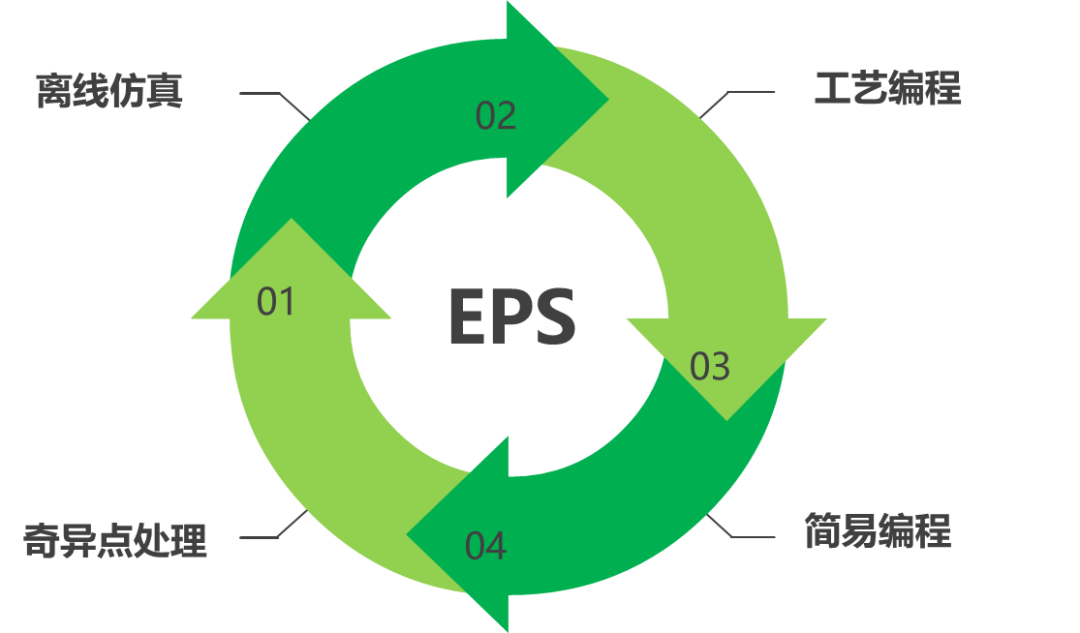
With the help of the offline programming software EPS, system integrators are not only able to carry out rapid simulation and validation during the initial design phase, thereby reducing the time required for commissioning spray robot production lines and avoiding potential risks in actual production, but they can also quickly adjust and write spray process programs, rapidly utilize the functions of the spray process software package EPA, and map spray robots to actual production lines. This enables them to adapt flexibly to different spraying requirements, enhancing the flexibility of production line deployment and making process programming remarkably straightforward.
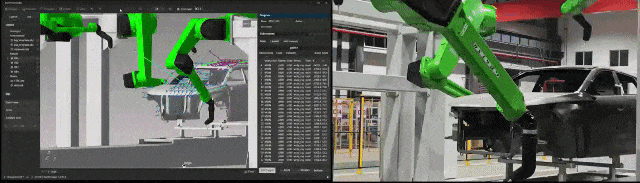
At present, most offline programming software on the market is essentially unable to generate robot programs that can be applied directly on site. This is because there are often discrepancies between the simulation layout and the actual layout; for a robot simulation programme to be applied on site, engineers must fine-tune it on site. This means that engineers can only complete simulation verification on site, and may even have to go through the process of re-optimizing trajectories and re-debugging parameters.
01. The ‘download-and-use’ program makes process programming more efficient
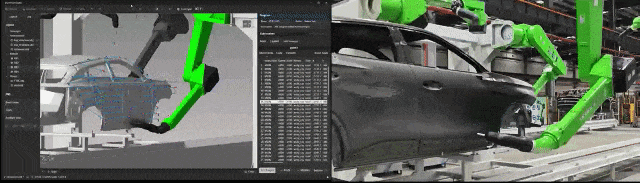
Once path trajectory design has been completed in the offline programming software EPS, the programme can be imported directly for execution on the robot. Furthermore, the format of the generated motion command programme is identical to that of traditional engineering formats, eliminating the need for trans-coding via third-party software or manual compilation, thereby enabling engineers to carry out bidirectional programme verification more swiftly.
This means that, in situations where there is a mix of product lines, the process conversion for Efort spray painting robots can be carried out during the production process. Companies need only flexibly adjust the programming parameters and trajectories of the spray painting robots in advance using the EPS offline programming software, according to different spray painting requirements and workpieces, without interrupting production, in order to adapt to different production processes and product requirements.
This flexibility in spraying is particularly essential on automotive production lines. For example, when a spraying production line needs to switch to the next batch of products, there is no need to halt production to programme the trajectory on-site, nor is it necessary for engineers to be present to carry out lengthy and tedious debugging of the spraying process; the robot immediately begins operating using the new trajectory programme generated off-line.
02. Automatic matching of process parameters makes process programming more efficient
Unlike traditional offline programming, which still relies on engineers to make numerous manual adjustments and edits to waypoints, with the aid of the Efort Virtual Controller, Efort painting robots are not only capable of executing traditional offline trajectory programs, but can also automatically match process parameters, covering the entire process from design and material movement to trajectory planning and process coding, thereby enabling the generation of complex painting programs.
03. The programme mirroring function makes process programming more efficient
For paint shop production lines with high standardization, the efficiency gains offered by the EPS offline programming software are even more pronounced. On established automotive production lines, painting robots are often arranged symmetrically. Using the EPS offline programming software, system integrators need only programme a single painting robot; the programs for subsequent robots can then be mirrored, enabling synchronized operation with identical trajectories and process parameters. This significantly reduces both robot deployment time and production downtime on automotive production lines, thereby accelerating project delivery.
04. The EPS and EPA combination makes process programming more efficient
Working in conjunction with EPA, the built-in spraying process software package for Efort spraying robots, the offline programming software EPS can also control tools such as brushes and spray guns. This enables the spraying robots to carry out tasks such as rapid automatic cleaning and quick automatic colour changes in a timely manner, without the need for re-calibration or frequent manual intervention, thereby truly achieving automated operations without any production downtime.


