Recently, the Efort ER15-1400 general-purpose robot successfully passed the 80.000-hour Mean Time Between Failures (MTBF) test and was awarded a reliability certification report by the National Centre for Robot Testing and Evaluation.
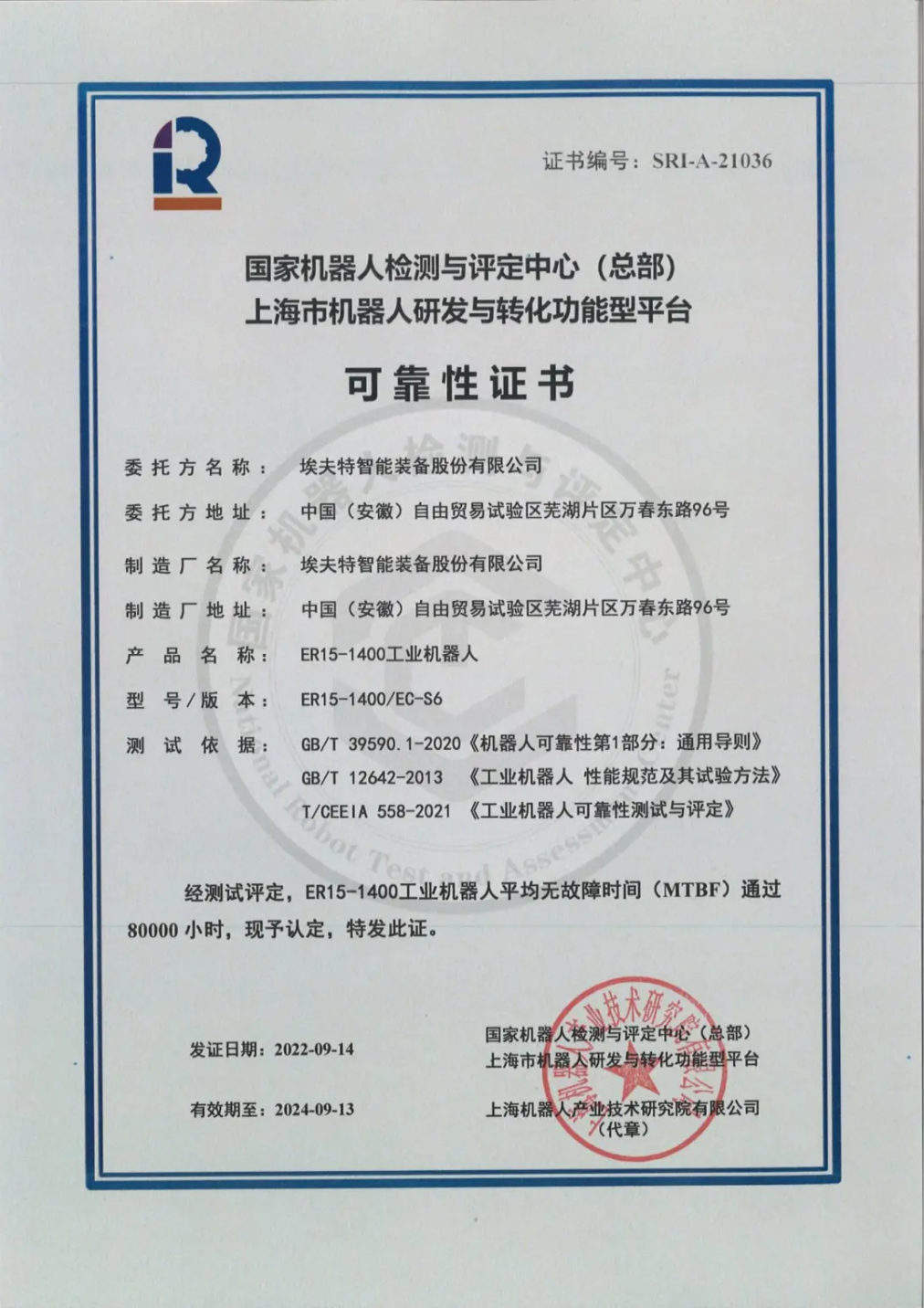
MTBF (Mean Time Between Failure), also known as the average time between failures, is a reliability metric used to assess a product (particularly electrical appliances). It is measured in ‘hours’. It reflects the product’s temporal quality and indicates its ability to maintain functionality over a specified period.
As a key indicator for assessing product reliability, MTBF is of paramount importance to users. Particularly in the highly competitive 3C and new energy sectors, selecting highly reliable products means reducing losses caused by production line downtime and maintenance, thereby helping to achieve better economic returns and enhance a company’s competitiveness.
High reliability, high production capacity, safety, smart technology and flexibility are the key trends driving the development of the 3C and new energy sectors.
The Efort ER15-1400, which participated in this test, is a high-speed, high-precision industrial robot that continuously helps end customers improve production efficiency, reduce operating costs, shorten product cycles, lower product defect rates and reduce energy consumption; it represents the goal of domestic robots in replacing imported ones. In the photovoltaic industry’s application of coating and tabbing graphite boats, the ER15-1400 achieves a gantry motion cycle time of two seconds whilst maintaining trajectory accuracy of 0.5 mm for tabs at high speeds. It has become the standout model among domestic brands as the only one capable of being applied in this process and sustaining highly efficient production.
In PCB placement applications within the 3C industry, as PCB product dimensions and fixture sizes continue to increase, the inertia of robotic end-effector and the reliability of their seals are rising rapidly. The ER15-1400 utilizes high-inertia motors and advanced hybrid technology, whilst its dual-seal design aligns with the future product development trends of end customers, enabling it to maintain its competitive edge in the industry.
EFORT ER15-1400 Robot
High-speed
The combination of trajectory speed, signal prediction and hybrid technology, together with the use of high-inertia motors, delivers industry-leading production speeds.
High precision
Repeatability of ±0.03 mm and absolute accuracy of ±0.2 mm, meeting the high-precision requirements of photovoltaic tab insertion applications.
Easy to use
Supported by an integrated manufacturing process package, user-centred design and a range of advanced technologies, it delivers an exceptional user experience. The slender, S-curved upper arm prevents interference with wrist movement, further expanding the range of motion whilst enhancing its aesthetic appeal.
Reliable
Sophisticated motion control algorithms, a modular hardware platform and a dual-seal design ensure the stable operation of the tab insertion equipment, which features IP67 protection and a dual-seal design on the main unit.
Efort places great emphasis on ensuring product quality and continues to devote significant R&D resources to enhancing reliability. Reliability considerations are incorporated into every robotic product right from the planning and conceptual design stages, and during the development and validation phases, the company strictly adheres to national and international standards to carry out rigorous, multi-dimensional and multi-level testing, whilst continuously conducting in-depth research.
The fact that the ER15-1400 has been validated under extremely rigorous testing conditions fully demonstrates the outstanding quality of Efort robot products. The ER15-1400 is also able to cope with ease in application scenarios that place high demands on cycle time, inertia, rigidity and safety, providing customers with safer and more reliable performance and quality.
MTBF
MTBF reflects a product’s reliability over time and represents its ability to maintain functionality within a specified period.
The longer the MTBF, the higher the product’s reliability and the greater its ability to operate normally. This test provides evidence of the product’s reliability and enables companies to derive further ideas for product optimization.
Through the development of a reliability platform, the formulation of national standards and research into implementation plans, the Shanghai Robotics Industry Technology Research Institute has established capabilities for the testing and evaluation of robot MTBF.


